
Private charter flight Nashville
A private charter flight Nashville travelers book most often lands at Nashville International, where one runway stretches 11,030 feet. Summer heat pushes density altitude to about 2,700 feet in July, which shapes aircraft choice. Here is how the field actually works.
- KBNA · BNAfield codes
- 599 ftfield height
- 11,030 ftlongest strip
- 0 mito New York
Nashville International sits 599 feet above sea level and handles the private charter flight Nashville passengers request most, with a runway long enough that takeoff performance is rarely the deciding factor. The jet you pick matters more than the field itself. Light jets work the shorter regional legs, midsize aircraft cover the coast-to-coast runs, and long-range types handle the transcontinental trips. A private charter flight Nashville passengers book on a midsize jet reaches most Eastern U.S. cities nonstop.
The airport serves the whole metro, from downtown and the Gulch to Franklin and Murfreesboro, and fixed base operators on the field handle arrivals without the commercial terminal. That matters if your day starts with a meeting and ends with a flight home. Nashville private jet travelers arriving at KBNA clear the FBO ramp rather than the main terminal and are in a car within a few minutes of engine shutdown, which is the reason many people choose the field over driving to a second airport.
This page covers the runway picture, the four FBOs on the field, how heat and humidity change takeoff performance across the year, which trips suit which aircraft, and how ground access works. Prices quoted anywhere on this site are estimates, so treat any figure as a starting point and confirm against a live quote for your dates.
Getting to and from the airport
The airport sits a short drive from downtown Nashville, and the surrounding interstate network makes the trip from the Gulch, East Nashville or Franklin straightforward outside rush hour. Your operator's FBO choice determines which side of the field you arrive at, so confirm the address rather than the airport name. A private charter flight Nashville passengers take from KBNA starts with a car transfer to the correct FBO, not the main terminal. If you are connecting to a commercial flight, then you will move to the main terminal and pass through TSA screening, which adds time the private arrival did not require.
Private jet routes via Nashville
The 6 private jet city pairs here span 199 to 2,129 nautical miles, with one-way light jet quotes running $4,000 to $36,000.
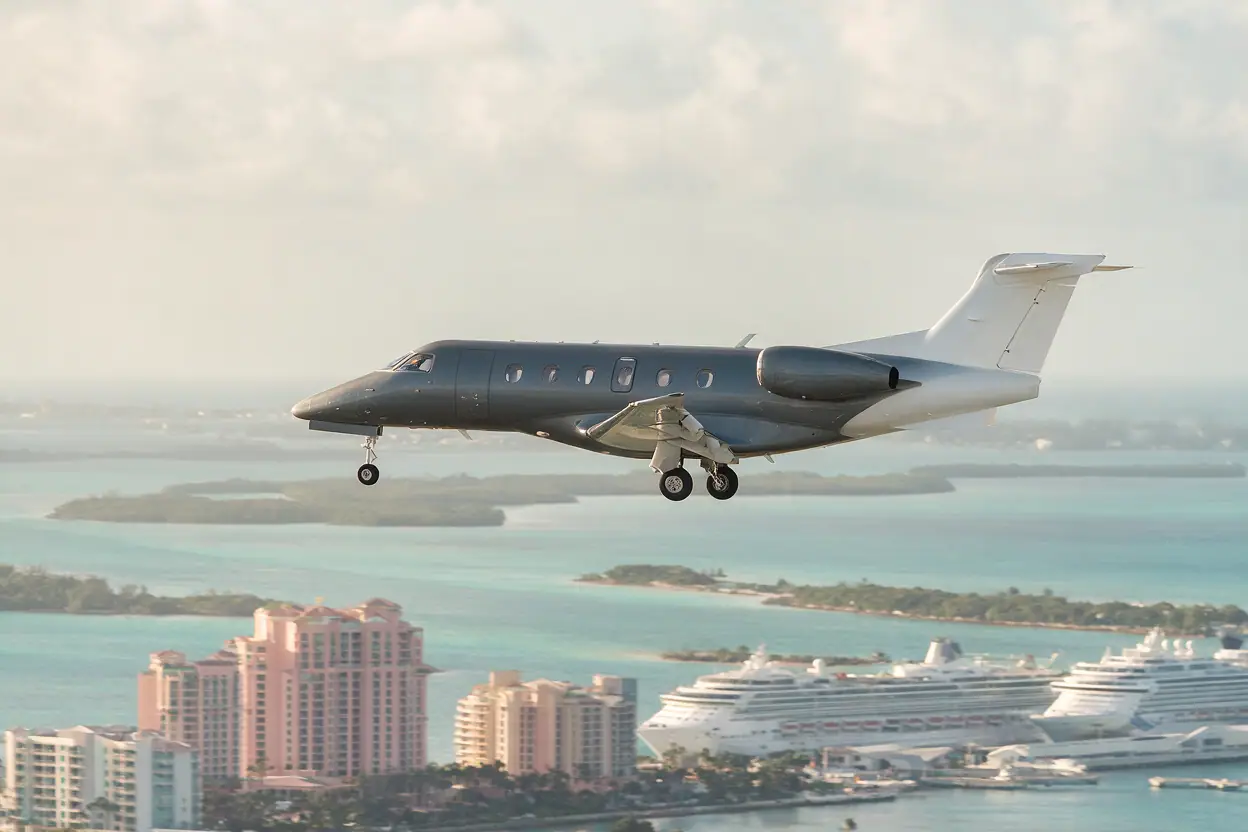



Runways at Nashville International
Nashville International has a longest runway of 11,030 feet at 599 feet elevation, so almost any business jet in charter service can operate here at full or near-full fuel loads in cool weather. The field's long runway pairs with parallel runways, which keeps departures moving when traffic builds. The main runway at BNA measures 11,030 feet and suits heavy long-range jets in cool months. That length is the reason a transcontinental departure can leave Nashville with full tanks in January and still clear terrain comfortably.
If a winter cold front drops temperatures into the 40s, then takeoff performance is at its best and even a small jet can carry a full load of passengers and bags. If your trip falls in the middle of July, then plan on the runway doing less work for you and let aircraft selection do more. If you are comparing two jets for the same trip, then the runway length at Nashville rarely decides it, but the hot-day performance at your destination airport often does.
| Rwy | Length | Width | Pavement |
|---|---|---|---|
| 13/31 | 11,030 ft | 150 ft | Asphalt |
| 02C/20C | 8,001 ft | 150 ft | Concrete |
| 02R/20L | 8,001 ft | 150 ft | Concrete |
| 02L/20R | 7,704 ft | 150 ft | Concrete |
Heat, humidity and density altitude
Nashville's warmest month averages a high of 89 F, and with the standard 8 F margin the field's peak density altitude reaches roughly 3,300 feet, with July itself around 2,700 feet. Those figures are performance numbers, not comfort numbers. Peak density altitude at KBNA reaches about 3,300 feet in the hottest month of the year. At that level, a lightly loaded jet climbs normally and a fully loaded one may need a longer takeoff roll or a fuel stop that a January departure would not.
The season changes the number steadily. January sits at sea-level-equivalent performance, April climbs to about 1,400 feet, June reaches 2,500 and August holds near 2,600 before the fall drop. If you are flying a long leg with a full cabin in July, then your operator may shorten the fuel load or plan a tech stop, and that is a normal trade rather than a problem. If you travel in October or November, then density altitude falls back to 1,700 and 800 respectively, and the same aircraft carries more.
Rain matters too. July averages 17 wet days, the wettest month on the calendar, so build a little slack around summer departures. If a thunderstorm parks over the field, then departures hold until it clears, and a morning slot is usually the safer bet.
| Mo. | Typical high | Days with rain | Density alt |
|---|---|---|---|
| Jan | 48°F | 11 | 0 ft |
| Feb | 53°F | 13 | 300 ft |
| Mar | 61°F | 13 | 900 ft |
| Apr | 69°F | 12 | 1,400 ft |
| May | 79°F | 13 | 2,100 ft |
| Jun | 86°F | 14 | 2,500 ft |
| Jul | 89°F | 17 | 2,700 ft |
| Aug | 87°F | 15 | 2,600 ft |
| Sep | 83°F | 9 | 2,300 ft |
| Oct | 73°F | 9 | 1,700 ft |
| Nov | 60°F | 9 | 800 ft |
| Dec | 53°F | 11 | 300 ft |
FBOs on the field
Four fixed base operators serve general aviation at Nashville International: Atlantic Aviation, Azure Flight Support, Contour Flight Support and Signature Aviation. Which one your flight uses depends on your aircraft size and the operator's arrangement, not on a public ranking, so ask when you book. Nashville private jet arrivals can use Atlantic, Azure, Contour or Signature on the field.
If you are flying in for a Predators game or a weekend on Broadway, then the FBO choice is a detail you can leave to the operator. If you need a specific amenity, a particular ramp or a quick car transfer, then say so before the quote is finalized so the right facility is built into the plan.
Trips that suit Nashville
- Light jets for regional legs such as Nashville to Charlotte, Atlanta or Dallas Love Field, where the flight is short and the cabin size is secondary.
- Midsize jets for coast-to-coast runs to Teterboro, Van Nuys or Opa Locka, where range and baggage space both count.
- Turboprops and light jets for short hops to smaller regional fields that cannot take a larger aircraft.
- Larger cabin aircraft for groups heading to South Florida or the West Coast, where the extra cabin length makes a long leg comfortable.
| Aircraft | Typical runway need | Local |
|---|---|---|
| Turboprop | 3,300 ft+ | Will fit |
| Light jet | 4,000 ft+ | Will fit |
| Midsize jet | 5,000 ft+ | Will fit |
| Super-midsize jet | 5,200 ft+ | Will fit |
| Heavy jet | 5,600 ft+ | Will fit |
Questions about this airfield
Which airport does a private charter flight Nashville use?
Most private charter flight Nashville departures use Nashville International, KBNA, at 599 feet elevation with a longest runway of 11,030 feet. It is the primary field for the metro and has four FBOs on site. Smaller regional fields nearby can work for light aircraft, but the main field suits everything from light jets to long-range types.
Does summer heat affect departures from Nashville?
Yes. The field's warmest month averages a high of 89 F, and peak density altitude reaches about 3,300 feet, with July around 2,700 feet. That can reduce payload or range on a hot afternoon. Flying earlier in the day or choosing a larger aircraft are the usual ways to work around it.
How long is the runway at Nashville International?
The longest runway at KBNA measures 11,030 feet, which is enough for heavy business jets at near-full fuel in cool weather. In the heat of summer, performance drops but the field still handles most charter aircraft comfortably. Runway length rarely limits a trip here.
How many FBOs serve general aviation at BNA?
Four: Atlantic Aviation, Azure Flight Support, Contour Flight Support and Signature Aviation. Which one handles your flight depends on your aircraft and the operator's arrangement. Ask for the address when your trip is confirmed so your car goes to the right ramp.
What aircraft fits a coast-to-coast trip from Nashville?
Midsize and larger jets cover transcontinental legs to Teterboro, Van Nuys or the Miami-area fields without a stop in cool weather. In July, a heavy passenger load on the longest legs may need a fuel stop. Compare two aircraft types on the same dates before you decide.
When is the easiest season to fly out of Nashville?
Late fall and winter offer the best performance. October density altitude sits near 1,700 feet and November near 800, so aircraft carry more fuel and payload. July is both the hottest and the wettest month, with 17 wet days on average, so summer departures benefit from a little scheduling slack.